Recording a life story
How to record a parent’s life story
Choose a format your parent is comfortable with, writing, audio or video, then meet for short sessions and take one part of their life at a time with specific questions. Label and save each session as you go, and you will have their story in their own words within a few months.
By Porch Stories · Last updated
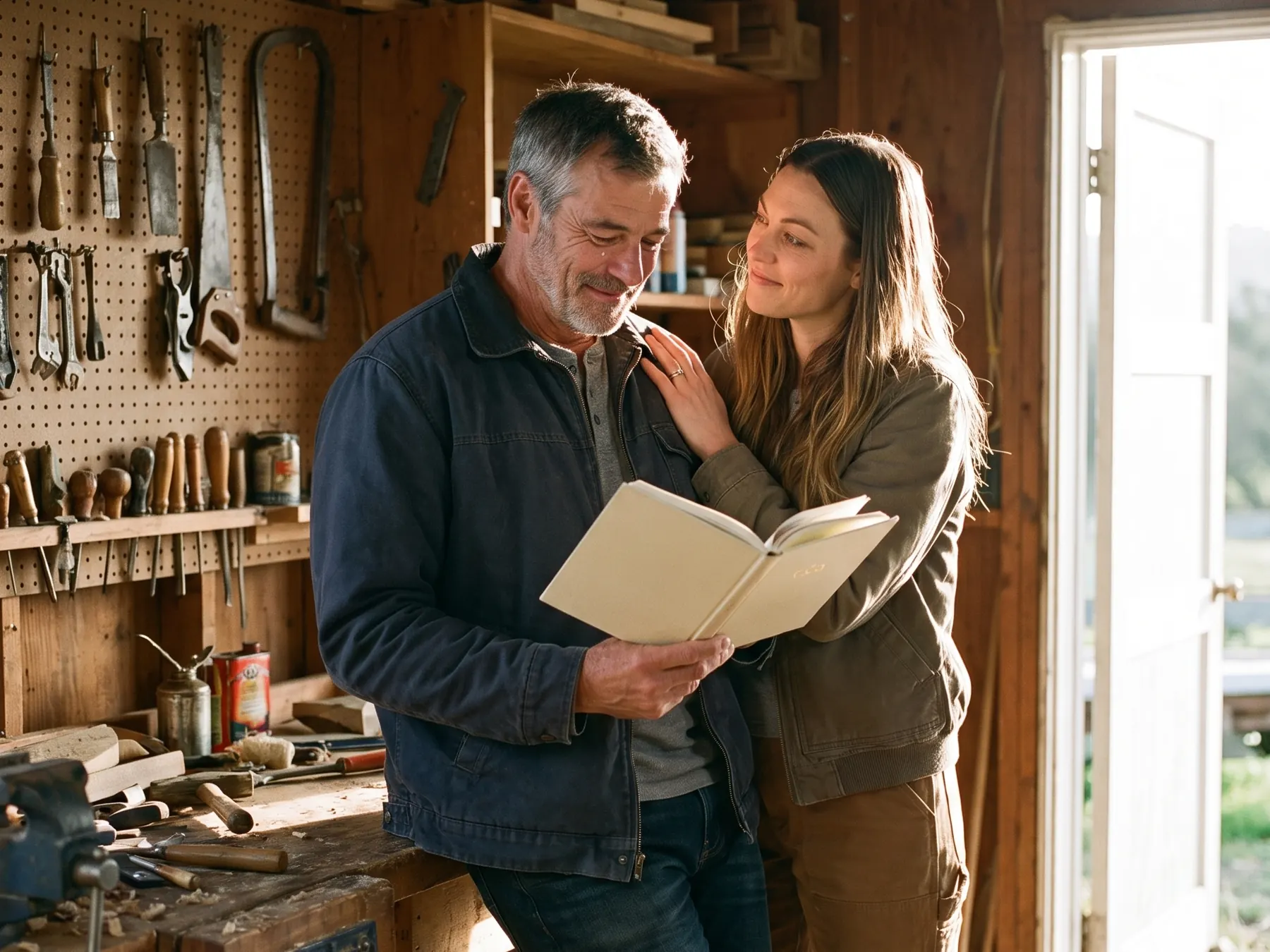
You do not need to be a writer or a filmmaker
Recording a parent’s life story sounds like a big undertaking. In practice it is a series of good conversations, with a little care taken to keep what is said. You need curiosity, a quiet hour now and then, and one simple way to capture the answers.
The holidays are a natural time to begin. You are together, the pace is slower, and old photos and familiar dishes are already bringing memories to the surface. Start with one session this Christmas and let it grow from there.
Step 1: choose the format
There are three good ways to record a life story. The best one is the one your mom or dad will enjoy, so ask which appeals to them.
- Writing by hand. Your parent answers questions in a journal, in their own words and handwriting. It can be done alone, at their own pace, and the finished book needs no device to read. It suits people who like a quiet hour and a pen.
- Audio. You talk, and a phone records. It is the easiest way to capture a lot of story quickly, and it keeps the voice, the laugh and the turns of phrase. It suits natural talkers.
- Video. The same conversation, with a face and gestures. It asks a little more of the person being filmed, so offer it only if they are comfortable on camera.
Many families mix two. A common and happy combination is a guided journal as the backbone, with a recording running while you fill in the pages together. The journal gives you the questions and a written record; the recording keeps everything that did not fit on the lines.
Step 2: ask first, and set the tone
Before any recording, tell your parent what you have in mind and why. Keep it warm and simple: you enjoy their stories, the grandchildren ask about the family, and you would love to have it in their own words.
Make three promises. They decide what to talk about and what to leave out. Nothing will be shared beyond the family without their say. And there is no test at the end: short answers, wandering answers and “I do not remember” are all welcome.
Always ask before you press record, every time. A parent who knows they are in charge relaxes, and a relaxed parent tells much better stories.
Step 3: plan short sessions by theme
A whole life is too much for one sitting. Break it into parts and take one part per session. Half an hour to forty-five minutes is plenty; stop while it is still enjoyable and you will both look forward to the next one.
A simple order that follows a life works well:
- Childhood: where they were born, the home, their parents, brothers and sisters.
- School days: teachers, friends, what they were good at.
- Growing up: the teenage years, music, first freedoms.
- Work and purpose: first jobs, what they did for a living, what they are proud of.
- Love: how they met, the early years together.
- Family: becoming a parent, raising children, family traditions.
- Home and everyday life: the houses, the routines, the food, the holidays.
- Life lessons: what they have learned and the advice they would give.
- For the next generation: what they hope the family remembers and keeps.
You do not have to go in order. If your dad is in the mood to talk about his first car, that is today’s chapter.
Step 4: ask questions that open a story
A good question is specific and cannot be answered with yes or no. It asks for a scene: a place, a person, a day. Prepare four or five for each session and expect to use two or three. Here are five from our journals that suit a first conversation with a parent.
- When and where were you born?
- What is your earliest memory?
- What did the house you grew up in look, sound and smell like?
- What were your parents like?
- What games did you play, and who did you play them with?
There are many more, sorted by theme, in our questions to ask your parents. Once a story starts, follow it. Ask for names and places, ask what things looked like, and let pauses be. The best material usually arrives a few seconds after you think the answer is over.
Step 5: set up the recording
The phone in your pocket is all the equipment you need. A few small habits make the result much nicer to listen to.
- Pick a quiet room. Turn off the television and the dishwasher, and close the window if the street is busy.
- Sit close, at a table or side by side on the sofa, with the phone between you and nearer to your parent.
- Use the voice recorder already on the phone. Do a ten-second test and play it back before you begin.
- For video, prop the phone at eye level, face your parent toward a window so the light falls on them, and frame head and shoulders.
- Start each recording by saying the date, who is speaking and the topic. Your future self will be grateful.
- Have a glass of water, the old photos and any keepsakes within reach. Objects bring back details.
Step 6: label it and keep it safe
A recording nobody can find is not much use. Spend five minutes after each session on housekeeping.
Rename the file with the date, the name and the theme, such as “2026-12-26 Dad childhood.” Keep all the sessions in one folder, and put a copy in a second place, so the story does not depend on one phone. Share the folder with your brothers and sisters so the whole family has it.
Then write down the highlights while they are fresh: a few lines, a great quotation, the names that came up. If your parent is filling in a journal, this is the moment to copy the best lines onto the matching pages, or to let them do it in their own hand.
A guided journal as the backbone
If planning the questions feels like the hard part, let a journal do it for you. A guided memory journal is a ready-made interview: the questions are written, they follow the order of a life, and every answer has a page.
Our Tell Me Your Story, Mom and Tell Me Your Story, Dad journals each have 100 guided questions in ten chapters, from childhood and first love to work, family and the lessons of a lifetime, plus 120 quick memory questions about favorite songs, first cars, recipes and the little things. There are photo pages, then-and-now pages, a family tree, a keepsakes page and a page for a letter to the next generation.
They are printable digital downloads: five PDF files in US Letter and A4, in full color and ink saver, plus a printable cover. Print one at home or at a local print shop, or fill it in on a tablet. Your parent can write alone, or you can ask the questions out loud, record the conversation and write the answers down together. There are editions for Grandma and Grandpa too, and the page about the journals has the full details.
If your parent prefers talking to writing
Some people will never pick up a pen but will happily talk for an hour. Work with that. Ask the questions, record the answers and do the writing yourself afterward.
There is also a way to make it a weekly habit without any planning on your side. A Year of Stories sends one question a week, and your parent answers by talking. It suits families who live apart, since nobody needs to be in the same room.
Keeping the momentum
The first session is the hardest to arrange and the easiest to enjoy. After it, put the next one on the calendar before you leave. A regular slot, such as the first Sunday of the month or a weekly phone call, keeps the project moving. One question a week fills most of a journal within a year.
Involve the rest of the family as you go. Play a short clip for the grandchildren. Read one answer aloud at Sunday dinner. Ask a brother or sister to lead the next session, since each of you will think of different questions. When your parent sees how much the family enjoys the stories, they will bring more of them to the table.
If this is going to be a Christmas present, wrap the journal with a note that says which story you want to hear first. Our guides to sentimental gifts for Mom and gifts for a dad who has everything have more ideas, and how to make a family history gift for parents shows how to combine a journal with photos, recipes and a family tree.