Filling in a memory journal
What to write in a memory journal
Write the way you talk: a few honest sentences that answer the question, with the names, places and small details that make the memory yours. It does not need to be long, polished or in order, because the family is hoping for your voice, not a perfect page.
By Porch Stories · Last updated
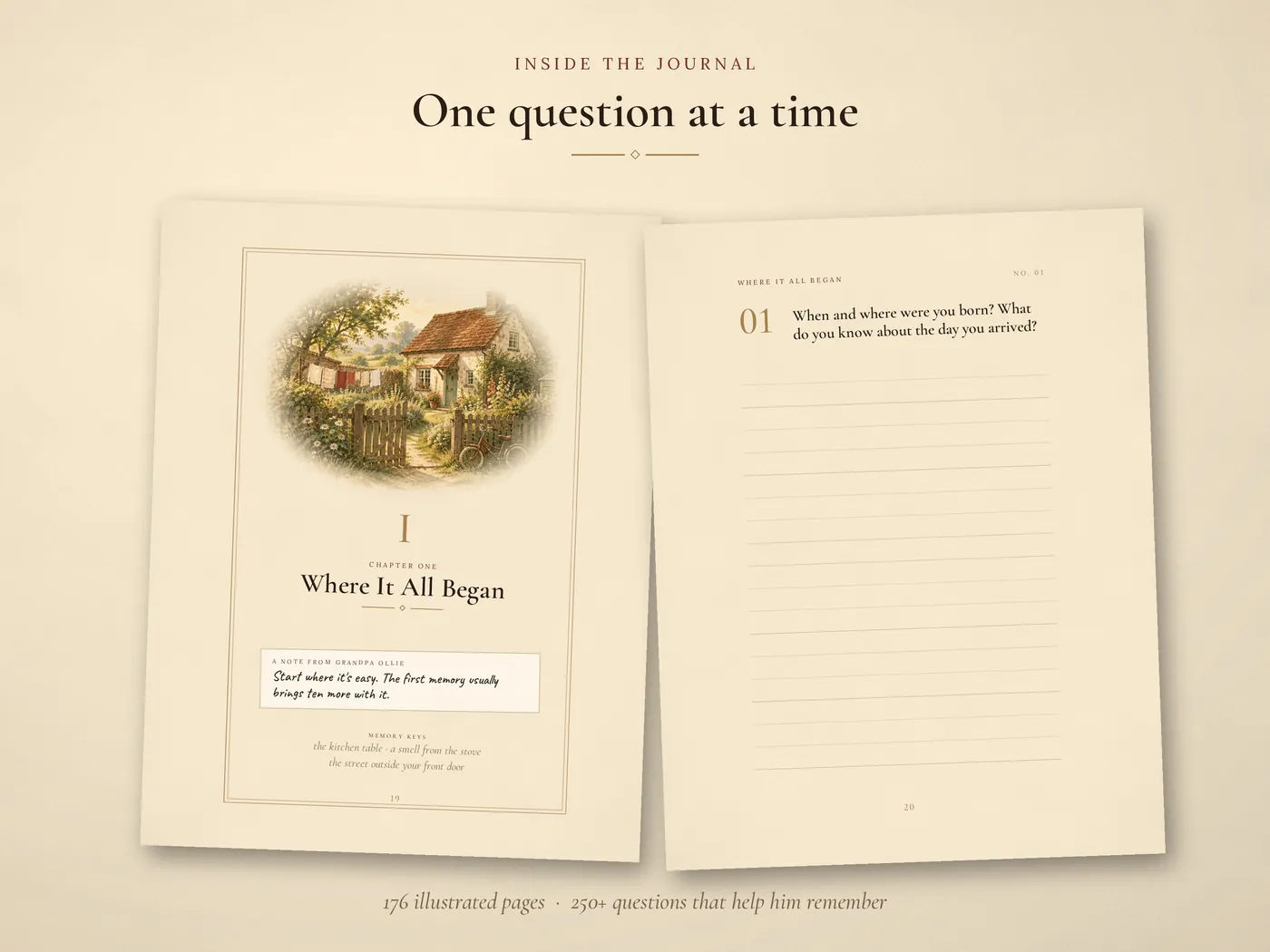
If you have just been given a memory journal
Someone in your family has handed you a book of questions about your life. It is a lovely compliment, and it can also feel like a lot. Where do you begin, and what are you supposed to say?
Here is the reassuring part: there is no way to get it wrong. The person who gave you the journal is not looking for fine writing. They want to know what your days were like, who you loved, what made you laugh and what you figured out along the way. A plain answer in your own handwriting is exactly what they hoped for.
The ideas below will help you start and keep going. If you are the one giving a journal, the later sections are for you.
Answer the way you talk
Imagine a grandchild sitting across the kitchen table asking you the question on the page. Whatever you would say out loud is what belongs in the journal. Use your own words and your own expressions, including the ones the family teases you about. Those are the lines they will treasure.
Start with the first thing that comes to mind. It is usually the right thing. You can always add a line later if another memory arrives, and it often does once the first one is on paper.
Do not worry about spelling, grammar or neat handwriting. A crossed-out word shows a real person was thinking. Nobody will be grading the page.
Add the details that make it yours
The difference between a short answer and a memorable one is detail. You do not need many. Two or three specifics turn a general statement into a scene the reader can see.
- Names. Not “my friend” but the friend’s name, and a nickname if there was one.
- Places. The street, the town, the room in the house, the seat you always took at the table.
- The senses. What it smelled like, what was on the radio, what the weather was doing.
- Numbers. How old you were, what the first paycheck came to, what a movie ticket cost.
- What people said. A parent’s favorite saying, a teacher’s one-liner, the exact words of a proposal.
- How you felt. Proud, nervous, homesick, thrilled. One word is enough.
Here is how that looks in practice. Asked about a first job, one answer might be: “I worked at a grocery store.” A fuller one might be: “The summer I turned sixteen I bagged groceries at the corner market on Elm Street. The owner paid us on Fridays in a small brown envelope, and I spent the first one on a record I played until it wore out.” The second takes a minute longer to write, and the family will read it for generations.
The ordinary days are the interesting ones
Many people skip the everyday because it seems too plain to write down. For your family, it is the most fascinating part. What you ate for breakfast as a child, how you got to school, what chores were yours, what a Saturday night looked like: these are the things that have changed the most, and the things nobody else can tell them.
Big events matter too, of course. Write about the wedding and the new baby. And give a few lines to the walk home, the kitchen, the first car and the neighbors. That is where a life is really lived.
What to do with a question that stumps you
Every journal has a few questions that do not fit your life or that you simply cannot answer today. You have good options.
- Skip it. Turn the page and come back another day, or never. Any order works, and no one will count the blank pages.
- Answer a nearby question. If the page asks about a favorite teacher and you had none, write about the person who did teach you something.
- Say so. “I honestly do not remember, but here is what I do remember from that year” is a perfectly good answer.
- Ask someone. A sister, a cousin or an old friend may remember, and the phone call is a pleasure in itself.
- Write as much or as little as you like. Some chapters of a life are more private than others. You decide what goes on the page.
Add more than words
A memory journal is a keepsake, and keepsakes can hold all kinds of things. If a page brings something to mind that is not a sentence, put it in.
Tape in a photograph and write who is in it. Copy out a recipe exactly as you make it, including the part that is not in any cookbook. Sketch the floor plan of your childhood home. Draw the route you walked to school. Write out the chorus of the song you danced to.
Our Tell Me Your Story journals leave room for this, with photo pages, then-and-now pages, a family tree, a keepsakes page and a page for a letter to the next generation.
How much, and how often
A memory journal is not meant to be finished in a weekend. It works best a little at a time, and there is no rush. One question a week fills most of the book within a year.
Find a small routine that suits you: Sunday afternoon with a cup of coffee, or one page before bed. Keep the journal and a pen you like somewhere you will see them. If you miss a week or a month, pick it up again where you left off.
Some days you will write three lines. Some days a question will open a door and you will fill the page and the margin too. Both are right.
If writing by hand is hard
Handwriting is wonderful to have, but it is not the only way to fill a journal. If your hand tires or you simply prefer to talk, ask someone in the family to sit with you. They read the question, you answer out loud, and they write down what you say. Many families find that this is the best part of the whole thing, because the conversation happens along the way.
You can also fill in the journal on a tablet. The printable files open in any PDF note app that lets you write on the page with a stylus or type with a keyboard.
If you are the one giving the journal
You can make the first page easy before the journal is even opened. Write a short dedication inside the cover: who it is for, who it is from, the date, and one or two things you are hoping to hear about. A line such as “I have always wanted to know what you were like at my age” does more than any instructions could.
Then offer your time. Suggest starting together, and ask the first question yourself. Tell them plainly that short answers are welcome, that they can skip anything, and that there is no deadline. Check in now and then by asking to hear an answer, not by asking how many pages are done.
If you have not chosen a journal yet, there is an edition for Grandma, Grandpa, Mom and Dad. Each has 100 guided questions in ten chapters and 120 quick memory questions, one question to a page, as a printable digital download. The page about the journals explains what is inside and how the files work.
A few questions to warm up with
If you would like to practice before you write on the real page, try answering one of these out loud. They come from the journals, and each links to a page with ideas for going deeper.
- When and where were you born?
- What is your earliest memory?
- What did the house you grew up in look, sound and smell like?
- What were your parents like?
You will find more in our questions to ask, including sets for parents and grandparents. And if the journal is going to be a Christmas present, here is how to give a digital gift on Christmas morning so there is something to unwrap. For more present ideas in the same spirit, see our guides to Christmas gifts for Grandma and Christmas gifts for Grandpa.