Christmas table questions
12 Christmas questions to ask your grandparents at the table
The best Christmas questions for grandparents ask for one clear picture: the tree in their childhood home, the food on the table, the present they remember most. Below are twelve to ask at dinner, in three groups, with simple ways to keep the story going once it starts.
By Porch Stories · Last updated
How to use these questions
You do not need all twelve. Two or three good questions are plenty for one dinner, and one story that runs long is better than a list that gets finished.
Choose the questions that fit your grandparent before you sit down. Someone who loves to cook will light up at a food question. Someone who was the oldest of six will have plenty to say about a crowded Christmas morning. Write your picks on a card and keep it by your plate, or cut the questions into slips and let the children draw them from a bowl.
Ask when the plates are full and the table has settled, or save them for dessert. Then give the answer room. The whole point is to hear something you have not heard before.
The questions are written for a grandparent, but they travel well. Great-aunts, old family friends and the parents at the table all have a Christmas morning they remember, and hearing two or three generations answer the same question is one of the pleasures of the evening.
Christmases when they were young
Start here. Childhood Christmases are happy ground for most people, the details are vivid, and the answers show the children at the table how different things once were.
- What did Christmas morning look like in the house where you grew up?
- Where did your family’s tree come from, and who decorated it?
- What is one present from your childhood that you still remember, and who gave it to you?
- What did your family eat at Christmas that you can still taste today?
These four work for any age at the table. A child can ask them just as well as an adult, and often gets a longer answer.
Family traditions and where they came from
Every family does a few things at Christmas without knowing why. Your grandparents are usually the ones who know. These questions tend to explain something the whole table has wondered about.
- Which of our family’s Christmas traditions is the oldest, and who started it?
- What is the story behind your favorite ornament?
- What was your first Christmas together like after you got married?
- What Christmas songs did your family sing or play, and who sang the loudest?
If an ornament, a dish or a recipe card comes up in the answer, go and get it. Passing the real thing around the table brings out the rest of the story.
People, laughter and what matters most
Save these for later in the meal, when everyone is relaxed. They are a little bigger, and they often produce the story the family retells next year.
- Who made Christmas feel special when you were a child, and how did they do it?
- What is the funniest thing that ever happened in our family at Christmas?
- What is your favorite memory of Christmas with our parents when they were small?
- What do you hope our family always keeps doing at Christmas?
The last question is a lovely one to end the meal with. It gives your grandparents the final word, and it tells the younger people at the table which traditions are theirs to carry on.
How to ask at a busy table
A Christmas table is loud, and grandparents are often the quietest people at it. A few small choices make it much easier for them to tell a story.
- Get the table’s attention first. Tap a glass or simply say that you have a question for Grandma. A story needs listeners.
- Ask one person, by name. A question thrown to the whole table usually gets no answer at all.
- Sit close. If hearing is hard in a noisy room, take the seat beside them or ask the question again over coffee in the living room.
- Let them finish. Keep side conversations for later, and let the pauses be. A pause usually means the next memory is on its way.
- Give everyone a turn. Once Grandpa has answered, let an aunt or a cousin answer the same question. The comparison is half the fun.
Keeping the story going
The first answer to a good question is often short. The story lives in what comes next, and you can invite it without a second list of questions.
Be curious about any detail they mention. If Grandma says the tree stood in the front room, ask her to describe the front room. If Grandpa mentions his sister, ask what she was like. Ask for names, places and the year, as near as they can remember.
Ask what things looked, smelled and sounded like. Senses bring memories back faster than facts do. And when the story reaches a natural end, say what you enjoyed about it. People tell more when they can see the story was welcome.
It also helps to offer a memory of your own in return. If Grandma describes the cookies her mother baked, tell her which of her dishes means Christmas to you. A story traded for a story feels like a conversation, and it often reminds her of one more thing she wanted to say.
Let the children ask
Children make wonderful interviewers. They ask without embarrassment, they want to know the practical details, and grandparents answer them with a patience nobody else at the table receives.
Give each child one question from the list above to be in charge of. Younger ones can draw the answer afterward; older ones can write it down. If your family enjoys this, our printable grandparent interview kit for kids gives young reporters question cards, a press pass and a front page for the story.
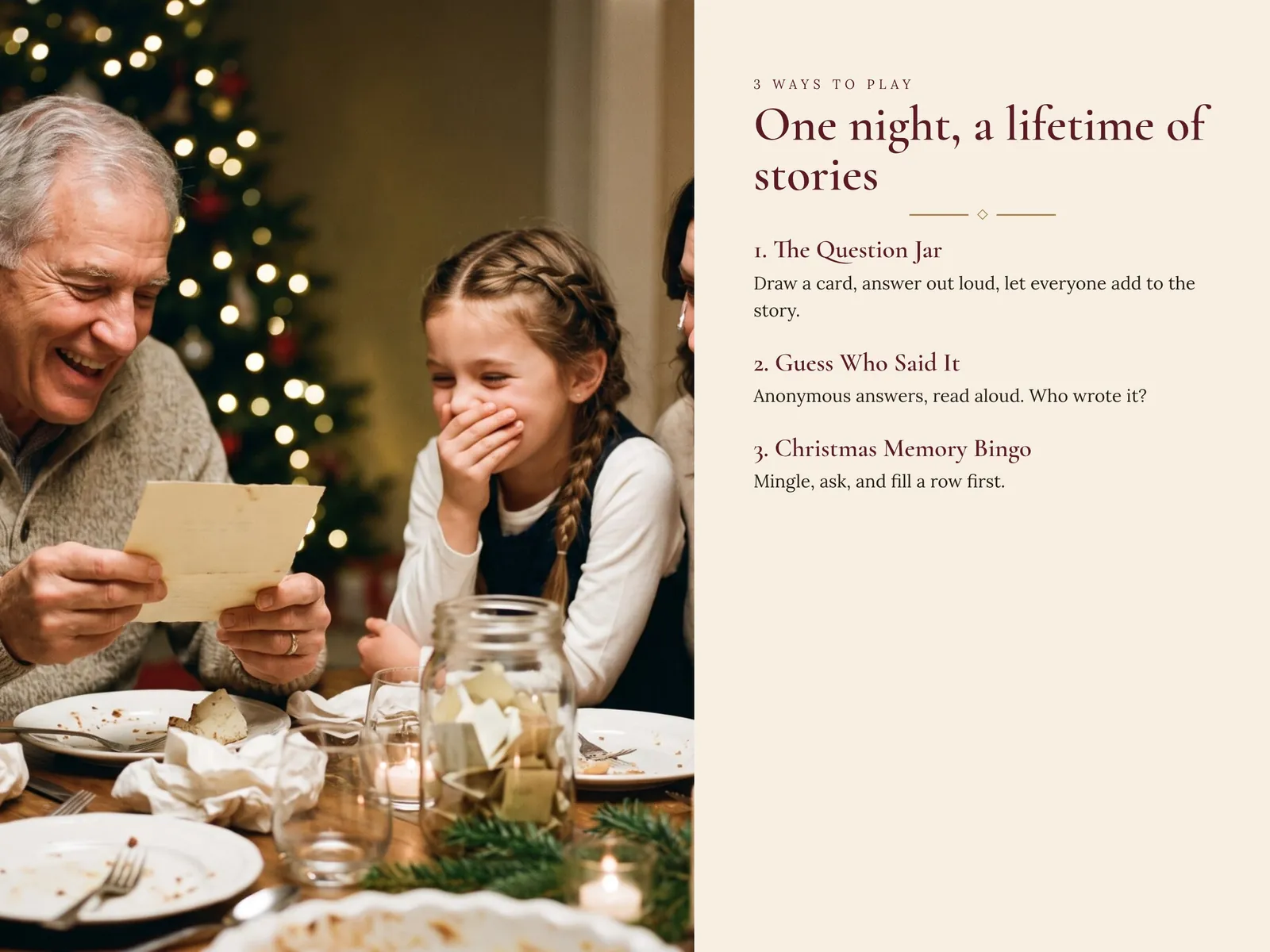
For a whole evening of questions with a bit of friendly competition, the Christmas Eve Family Question Game has 48 question cards in four categories and Christmas Memory Bingo.
Write the answers down
A story told over dinner is a gift to the people in the room. Written down, it reaches the cousins who could not come and the children who are too young to follow it yet.
It takes very little. Ask one person to be the note-taker for the evening, or write a few lines the next morning while it is fresh: the question, who answered, and the answer in their own words. Add the date. A page like this, tucked in with the Christmas decorations, becomes something the family reads again every December.
If you would like a proper home for the answers, a guided memory journal gives each story a page. Our Tell Me Your Story, Grandma and Tell Me Your Story, Grandpa journals ask about a whole life, not only Christmas: 100 guided questions in ten chapters plus 120 quick memory questions, with photo pages and a family tree. They are printable digital downloads, so you can print one in time for the holiday and begin at the table.
After Christmas: more questions for the rest of the year
Twelve questions will not cover a life, and they are not meant to. What they do is show your grandparents that the family wants to listen. After that, asking gets easier every time.
When the holiday is over, keep the habit small and regular: one question on each phone call or each visit. You will find a selection, sorted by theme, in our questions to ask your grandparents, and a wider collection for moms and dads too in questions to ask. If your parents will be at the table this year as well, there is a set for them in questions to ask your parents.
And if you are still choosing a present, a journal full of questions pairs naturally with a dinner full of them. Our guides to Christmas gifts for Grandma and Christmas gifts for Grandpa have more ideas in the same spirit.