Christmas Eve traditions
Christmas Eve family traditions that start conversations
The Christmas Eve traditions that get a family talking are simple and repeatable: one question at the table, the story behind an ornament, a family recipe cooked together, a letter to open next year. Each gives grandparents, parents and children a reason to tell a story, and all nine below need almost no preparation.
By Porch Stories · Last updated
Why Christmas Eve is the right night
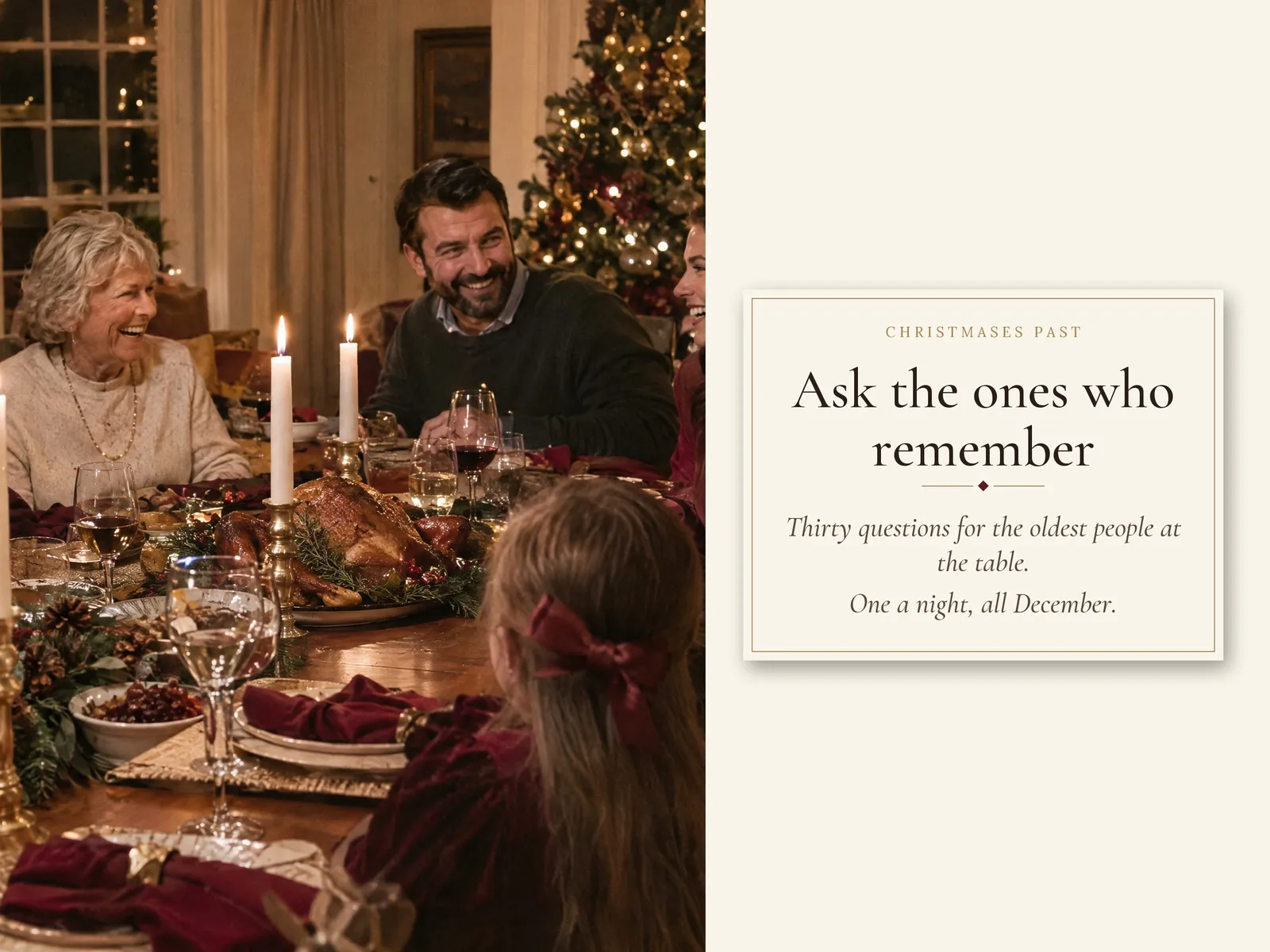
Christmas Day belongs to presents, cooking and visitors. Christmas Eve is different. The work is mostly done, the children are excited and awake, and the family is in one room with nowhere else to be. It is the one evening of the year when three generations will happily sit and listen to each other.
A tradition gives that evening a shape. It does not need to be elaborate. The ones that last are small, take a few minutes and are easy to repeat next year. What they have in common is that they hand someone the floor and give everyone else a reason to listen.
Here are nine that families return to. Choose one or two for this year. If one of them works, you will know by the way people ask for it next December.
1. One question for the whole table
Before dessert, one person asks a single question and everyone answers it in turn, oldest to youngest or youngest to oldest. Keep the question easy and concrete: a favorite Christmas memory, the best present ever received, the first Christmas each person can remember.
The pleasure is in the comparison. A grandfather’s first Christmas memory and a six-year-old’s sit side by side, and the table learns something about both. Let a different person choose the question each year. If you would like some to choose from, there are 12 Christmas questions to ask grandparents ready for the table.
2. The ornament story
Every tree has a few ornaments with a history: the one from a first apartment, the one a child made in kindergarten, the one that came from a great-grandmother’s tree. On Christmas Eve, each person picks one ornament and tells where it came from.
Grandparents usually hold the oldest stories, so let them go last. Children love discovering that the slightly battered star has been in the family longer than their parents have. To keep the stories for later, write a line about each ornament on a card and store the cards in the ornament box.
3. A family recipe, with its story
Choose one dish that has been in the family for a long time and make it together on Christmas Eve, with the person who knows it best in charge. While the dough rests or the pot simmers, ask where the recipe came from, who taught it, and what the kitchen was like back then.
Recipes are family history you can taste. Write this one down exactly as it is made, including the pinch of this and the handful of that, and note who it came from. Next year, let a grandchild take the lead with the same card.
4. The photo box
Bring out one box or one album of old photos after dinner and pass the pictures around. This is not a slideshow and nobody needs to prepare. Someone holds up a photo, asks who it is, and the stories begin on their own.
Keep a pencil nearby and write names and years on the backs as you go. Limit it to one box each year. It keeps the evening light, and it leaves something to look forward to next Christmas Eve.
5. Young reporters
Give the children a job: tonight they are reporters, and their assignment is to interview a grandparent. Each child gets a notebook, a pencil and three questions, and reports back to the family before bedtime.
Grandparents answer children with a patience and playfulness that adults rarely see, and the children come away with a story that belongs to them. If you want everything ready to go, our printable grandparent interview kit for kids has question cards, cut-out press passes and a newspaper front page to write the story on.
6. A letter to open next Christmas Eve
Each person writes a short letter: what this year was like, what they are grateful for, what they hope for the next one. Younger children can draw a picture or dictate to an adult. Seal the letters in one envelope, write the year on it and pack it away with the decorations.
Next Christmas Eve, open the envelope and read the letters aloud before writing new ones. Within a few years the family has a stack of small time capsules, in everyone’s handwriting. Our printable Our Family Christmas journal includes pages for these letters, along with pages for each of the next ten Christmases.
7. A question game after dinner
Some families talk more easily when there is a game on the table. Question cards, drawn at random, take the pressure off: nobody has to think of what to ask, and the card is to blame if the question is a funny one.
You can make your own by writing questions on slips of paper and folding them into a bowl. Or print a set: the Christmas Eve Family Question Game has 48 question cards in four categories, Christmas Memory Bingo cards and a keepsake page.
8. The same story, every year
Most families have one story that has to be told at Christmas: the year the tree fell over, the year the power went out, the year the dog got to the turkey first. Make its telling official. Give it a regular teller and a regular moment, such as right after the plates are cleared.
Then, each year, invite one new story to join it. Ask a grandparent for a Christmas tale the children have never heard. Over time the family builds a small collection, and the youngest members grow up knowing them by heart.
9. One page in the family’s book
End the evening by writing something down. It can be as simple as a notebook that lives with the Christmas decorations: the date, who was there, what was eaten, the funniest thing anyone said and the best story that was told.
If a grandparent or parent in the family has a memory journal, Christmas Eve is a fine night to fill in one page together. Read one question aloud, listen to the answer and write it down. Our Tell Me Your Story journals for Grandma, Grandpa, Mom and Dad have 100 guided questions and 120 quick memory questions, one question to a page, so there is always a next page waiting for next time.
How to start a new tradition without making it awkward
A new tradition can feel forced the first time. A few small choices help it settle in.
- Start small. Choose one idea, and keep it to ten or fifteen minutes.
- Tell people ahead of time. A quick message, “we are each going to tell one ornament story this year,” lets the quiet ones think of something.
- Go first yourself. Your own short, relaxed answer shows everyone how it works.
- Let anyone pass. A tradition people are free to skip is one they come to enjoy.
- Give the children a role. If they are in charge of the question bowl or the envelope, the adults will follow.
- Do it again next year. A tradition only becomes one the second time.
When part of the family is far away
Most of these travel well. Put a phone or a tablet at the end of the table and let the faraway grandparents answer the table question on video. Hold ornaments up to the camera. Email the question cards ahead of time so they can print a set where they live.
A letter to open next year can be mailed, and a recipe can be cooked in two kitchens at once with the call running. The distance changes the logistics, and the conversation is every bit as good.
From one evening to the whole year
The nicest thing about a talking tradition is what it starts. Once grandparents see that the family enjoys their stories, they tell more of them, and the children learn to ask.
If Christmas Eve leaves you wanting more, keep going with one question on each visit or phone call. Our questions to ask your grandparents and questions to ask your parents are sorted by theme to make that easy. And if you are still choosing presents, a journal of questions fits naturally under the same tree: see our guides to Christmas gifts for Grandma and Grandpa or browse the shop.